Finished Enough: How Atlanta Screenwriters Can Break Free from the Revision Loop and Get Their Work into the World
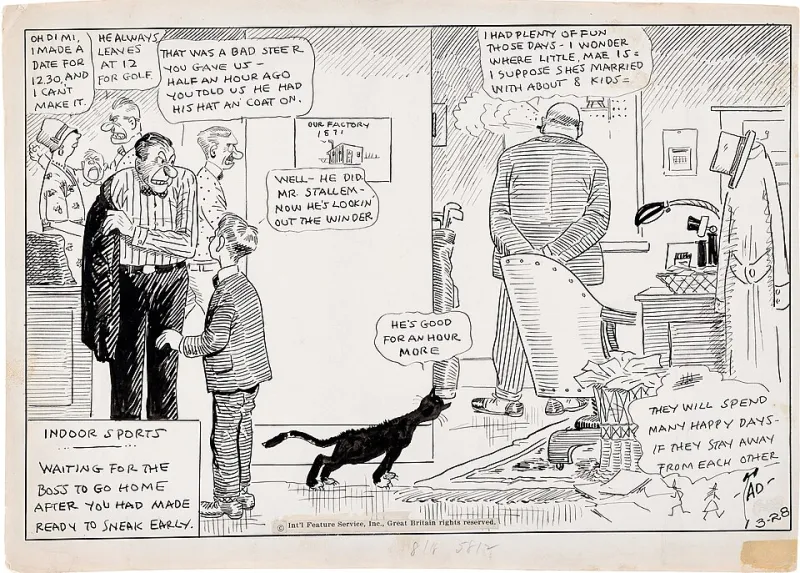
Photo: Tad Dorgan, Public domain, via Wikimedia Commons
There is a particular kind of paralysis that does not announce itself as fear. It arrives wearing the costume of professionalism—another pass at act two, another round of dialogue polish, another structural reconsideration before the script goes out. For a significant number of Atlanta screenwriters, this behavior does not represent craft refinement. It represents avoidance. And in a film market as competitive and opportunity-rich as Georgia's, the cost of that avoidance compounds with every month a script sits in a drawer instead of a producer's inbox.
Understanding why talented writers fall into chronic revision cycles—and how to escape them—may be one of the most consequential career conversations happening in Atlanta's screenwriting community right now.
The Illusion of Progress
Revision is essential. No serious writer disputes that. First drafts are exploratory documents, and the work of sharpening structure, deepening character, and refining language is where scripts genuinely improve. The problem emerges when revision stops serving the script and starts serving the writer's anxiety.
Psychologists who study creative professionals describe this pattern as a form of self-protective delay. If a script is never quite finished, it can never be rejected. The writer remains in a state of perpetual potential, shielded from the verdict of the marketplace. In Atlanta, where the industry infrastructure has grown dramatically over the past decade and genuine access to producers, development executives, and independent financiers is increasingly available, this protection mechanism carries a steep price.
Writers who have worked through Atlanta-based development programs describe the moment of recognition clearly. The script had been revised fourteen times over eighteen months. Each pass addressed something real, but none of them fundamentally changed what the script was. The honest admission: the revisions had stopped being about the work.
What the Market Actually Requires
One of the most clarifying reframes available to Atlanta screenwriters is a hard look at what the local and national market genuinely demands at the point of submission. Development executives at Georgia-based production companies are not expecting perfection. They are expecting a script that demonstrates a compelling premise, functional structure, distinctive voice, and commercial or artistic viability. These are achievable standards. They are not standards that require a fifteenth draft.
Producers consistently note that they can identify a script ready for development conversation within the first fifteen pages. What they are evaluating is not the absence of all rough edges—it is the presence of something worth developing. The distinction matters enormously for writers who have convinced themselves that one more revision will move their script from the rejection pile to the consideration pile. In most cases, the script was already in the consideration pile several drafts ago.
Atlanta's independent film community, which has produced regionally distinctive work that has traveled well nationally, operates with this understanding baked in. Scripts that enter development through those channels are not finished products. They are starting points for a collaborative process. Writers who treat submission as the end of their creative involvement, rather than the beginning of a professional conversation, are misreading how the industry actually functions.
Recognizing the Diagnostic Signs
How does a writer know when revision has crossed from productive to avoidant? Several reliable indicators have emerged from conversations within Atlanta's screenwriting community.
The first is the absence of specific, story-based reasons for continued revision. If a writer cannot name a concrete structural problem, a character arc that remains unresolved, or a thematic inconsistency that undermines the script's premise, the revision has no legitimate target. Polishing language for its own sake, adjusting formatting details, or revisiting scenes that already work are signs that the work is being delayed rather than improved.
The second indicator is the replacement of external feedback with internal reconsideration. Healthy revision processes involve readers—trusted peers, script consultants, writers' group colleagues. When a writer stops seeking outside perspective and instead continues revising in isolation, the process has likely become circular. Atlanta has a robust peer review culture, with multiple active writers' groups and professional development organizations. Writers who are not using these resources during extended revision periods should examine why.
The third sign is the repeated postponement of specific submission targets. A writer who had planned to submit to a particular competition, pitch to a specific producer, or enter a development program but deferred in order to revise further—and then deferred again—is exhibiting a pattern that warrants honest examination.
Practical Strategies for Establishing Revision Boundaries
The writers in Atlanta's community who have successfully broken the revision cycle tend to share certain practices. None of them are complicated. All of them require a degree of deliberate commitment.
Set a draft number before you begin. Deciding in advance that a script will receive three substantive revision passes—with a fourth reserved for notes received from external readers—creates a framework that contains the process. The number is less important than the commitment. Writers who establish this boundary before they begin drafting report significantly less difficulty declaring scripts ready for submission.
Attach revisions to specific feedback. Every revision pass should be driven by notes from an identifiable source: a writers' group session, a script consultant's coverage, a trusted colleague's read. Revisions that are not responding to external input are often responding to internal anxiety. This does not mean external notes are always correct, but it does mean revision should be a reactive process, not a preemptive one.
Create a submission calendar and treat it as a professional obligation. Atlanta's film calendar is dense with opportunity—competitions, pitch events, festivals, and production company open submission windows. Identifying three to five specific submission targets and assigning a script to each of them transforms submission from an abstract aspiration into a scheduled commitment. Missing a submission deadline because of an unplanned revision pass carries a concrete cost that can help recalibrate priorities.
Distinguish between development notes and completion notes. Some feedback is about making a script better. Some feedback is about making a script different—a matter of taste or preference rather than craft deficiency. Writers who treat all notes as equally urgent revision mandates will revise indefinitely. Learning to categorize feedback accurately is a skill that develops with experience and is worth cultivating deliberately.
The Career Cost of Waiting
Atlanta's film industry is not standing still while writers perfect their drafts. The production infrastructure that has made Georgia one of the most active filmmaking states in the country continues to evolve. New production companies are establishing local development arms. Streaming platforms are increasingly interested in regionally grounded stories. The window of opportunity that exists right now for writers with authentic Southern perspectives and commercially viable material is genuinely significant.
Writers who are holding finished—or functionally finished—scripts back from this market are not protecting their careers. They are allowing a specific, time-sensitive opportunity to pass. The script that goes out imperfect and generates a development conversation is worth more to a career than the script that achieves theoretical perfection in isolation.
The goal was never a flawless document. The goal was always a produced story. Reaching that goal requires moving the work from the desk into the world—and trusting that the world, and the collaborative process it initiates, will take care of the rest.
Finished enough is not a compromise. For Atlanta screenwriters ready to stop revising and start engaging, it is the most professional standard available.