Scene by Scene, Line by Line: How Atlanta Screenwriters Are Writing Sensitive Material That Works on the Modern Set
For years, the prevailing wisdom in screenwriting circles held that less was more when it came to intimate scenes. A vague stage direction — they fall into each other — was considered elegant shorthand, a signal to the director and actors that the writer trusted the room. That philosophy, while not entirely obsolete, has collided headlong with a professional landscape that now includes a dedicated specialist whose entire role is to translate the written word into safe, consensual, and emotionally truthful performance.
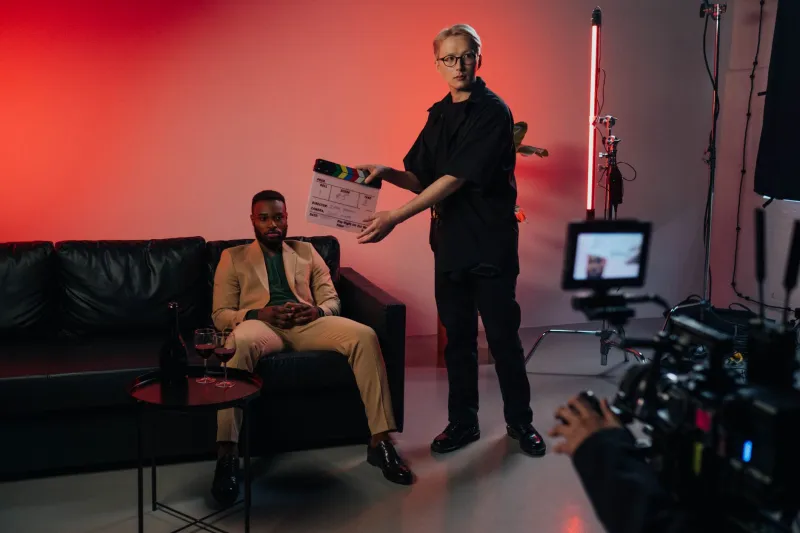
The intimacy coordinator has become a fixture on sets across Atlanta's major productions, from streaming originals shot at Trilith Studios to independent features filmed across Fulton County. Their presence is not merely logistical. It is creative. And for screenwriters, that distinction carries real consequences for how a script is written, read, and ultimately produced.
What the Page Signals Before Production Begins
Intimacy coordinators typically enter a production during pre-production, often reviewing scripts alongside directors and producers before casting is finalized. Their job, in part, is to assess the scope and nature of sensitive content so that appropriate planning, actor agreements, and choreography can be arranged well in advance.
What they frequently encounter in scripts written without this workflow in mind is ambiguity — and ambiguity, in this context, creates friction. A scene described only as intimate or passionate leaves too much undefined. It places the burden of interpretation on the coordinator, the director, and ultimately the actors, who may have contractual or personal boundaries that were never accounted for during the writing stage.
Atlanta-based screenwriters who have worked on productions where intimacy coordinators are embedded report a consistent observation: the writers whose pages required the least revision during pre-production were those who had already internalized a more deliberate approach to scripting vulnerable content.
The Language of Clarity Without Clinical Distance
One of the central craft challenges is writing intimate scenes that are both emotionally alive on the page and specific enough to be practically useful. This is not a contradiction, though it can feel like one to writers accustomed to the impressionistic tradition of screen direction.
The shift begins with verbs. Where a script might once have relied on atmospheric shorthand, contemporary professional standards increasingly favor action language that describes what is actually happening between characters — physically and emotionally — without crossing into directions that belong to the actor's internal process. The writer's domain is behavior. What a character does, not what a character feels in some unquantifiable interior sense.
This does not mean a script should read like a medical report. The emotional stakes must remain present and legible. A scene between two characters navigating grief, desire, and uncertainty can still carry all of that weight when the writer commits to specific, grounded action rather than relying on the reader to fill in the blanks. In many cases, the specificity itself generates the emotional resonance.
Screenwriting educators working with Atlanta-area writers have begun incorporating this framework into their instruction — encouraging writers to think of intimate scenes the way they think about action sequences. Choreography exists. Stakes are defined. The sequence has a beginning, middle, and end. The emotional arc is embedded in the physical specificity, not separate from it.
Notation, Blocking, and the Pre-Production Conversation
Beyond the scene itself, Atlanta screenwriters are learning to engage with the broader pre-production conversation around sensitive content in ways that previous generations of writers rarely considered their responsibility.
Some productions now request that writers include a brief content notation at the front of a script — a summary of scenes involving intimacy, violence, or other sensitive material, similar to the content advisories that appear on finished streaming releases. This is not a creative concession. It is a professional courtesy that accelerates the planning process and signals to producers that the writer understands how contemporary productions are assembled.
Others are incorporating what might loosely be called intent language into their scene work — brief parenthetical or prose notes that clarify the dramatic purpose of a sensitive scene without dictating performance. This moment marks the first time either character has allowed themselves to be fully seen. That kind of framing gives the intimacy coordinator, director, and actors a shared understanding of what the scene is meant to accomplish, which in turn informs the choreography decisions made in the room.
The writers who resist this kind of engagement sometimes cite creative autonomy as their reason. But the more experienced voices in Atlanta's screenwriting community tend to push back on that framing. Collaboration is not a threat to authorship. It is how professional screenwriting has always functioned. The intimacy coordinator represents one more collaborator in a process that has always involved directors, producers, actors, and department heads shaping the writer's vision.
What This Means for Writers at Every Level
For emerging screenwriters in Atlanta, the practical implication is straightforward: developing fluency in this approach now, before it is demanded of you, is a competitive advantage. Productions working at the level where intimacy coordinators are employed are also productions with more resources, more visibility, and more opportunities for a writer to build a meaningful career.
For working professionals, the invitation is to revisit assumptions about what the page is for. The script is not only a creative document. It is a production document. It communicates to a large team of specialists, and the clarity with which it does so has real consequences for how smoothly a production runs and how well the writer's original vision is served.
Several Atlanta-based writers who have navigated this transition describe the process as ultimately liberating rather than constraining. When a scene is written with enough specificity to function as a practical guide, it is also written with enough specificity to be genuinely moving. Vagueness rarely produces power. Precision, when it is grounded in character and stakes, almost always does.
The Broader Shift in Set Culture
Georgia's film industry has grown large enough and sophisticated enough that the practices once associated exclusively with major studio productions are now filtering down through the ecosystem. Intimacy coordinators are appearing on mid-budget independent productions. Standards that originated on premium cable and streaming sets are becoming baseline expectations across the industry.
Atlanta screenwriters who position themselves ahead of this curve — who understand the coordinator's role, who write with the production workflow in mind, and who treat sensitive scenes as craft opportunities rather than obligations — are the writers best prepared for the professional environment that already exists on the city's most active sets.
The page has always been where a production begins. Writing sensitive material with the skill and intentionality that the modern set demands is not a concession to external pressure. It is an expression of the same professional seriousness that defines every other aspect of the screenwriter's craft.